Estimate U.S. Sales Tax on Online Purchases in 15 Seconds (ZIP, 2026)

Most online purchases of physical goods get taxed based on where the package lands, not where the seller is based. That means your final price depends on the combined state and local rate at your shipping address. The fastest way to see the real number is a ZIP or full-address sales-tax calculator before you check out. Marketplaces typically collect this automatically; if a seller doesn’t, you may still owe the equivalent as use tax.
TL;DR:
- Most online purchases are taxed based on the destination shipping address, which can vary the total by 1 to 3 percentage points depending on local jurisdiction layers.
- Shipping charges are taxable only if they are bundled with the product in states that do not exempt separately stated shipping fees.
- Combining accurate ZIP-level sales tax rates with careful itemization of shipping costs helps shoppers estimate the final out-the-door price more reliably.
- Buyers should verify rates with official sources or address-specific calculators like TaxCloud to avoid unexpected charges at checkout.
- Using tools like Aipricesearch allows consumers to compare total, tax-inclusive prices across multiple sellers for more informed purchasing decisions.
Table of Contents
- How Sales Tax Sourcing Determines What You Pay Online
- What Actually Changes Your Final Out-the-Door Price
- A Simple Method to Estimate Your Total Before You Check Out
- Where to Check the Exact Rate Before You Buy
- How Aipricesearch Helps You Compare Tax-Aware Totals
- Do This Before Any Big Purchase
- Start Comparing Total Prices, Not Just Sticker Prices
- Where to Verify Rates Yourself
- Sources
- FAQ
How Sales Tax Sourcing Determines What You Pay Online
Here’s the rule that governs almost every online purchase of a physical item: tax follows the shipping address, not the store’s address. This is called destination-based sourcing, and it’s how the vast majority of states handle interstate online sales, according to Numeral’s breakdown of sourcing rules. Even in the handful of states that use origin-based sourcing for in-state sales, interstate shipments almost always default to the destination rule, which is why treating your ship-to ZIP code as the deciding factor is the safest assumption for online shopping.
What actually makes up that “destination rate”? It’s rarely just one number. A combined rate typically stacks four layers:
- The state’s base sales tax rate
- The county rate
- The city or municipal rate
- Special district taxes (transit authorities, school districts, hospital districts)
Those layers can shift the total by 1 to 3 percentage points even within the same metro area, based on Avalara’s guide to sales-tax jurisdictions. Two houses ten minutes apart can sit in different special districts and pay noticeably different tax on the identical order.
The math itself is simple once you have the right rate: Tax = Taxable subtotal × (Combined rate ÷ 100), and your final total is subtotal plus tax plus any taxable shipping. Five states, Alaska, Delaware, Montana, New Hampshire, and Oregon, charge no statewide sales tax at all, though Alaska allows local borough taxes, according to Avalara. One exception worth flagging: digital goods and subscriptions sometimes follow billing address or “address of use” rules instead of shipping address, so a streaming service or software license can be taxed differently than the sweater you just bought.
What Actually Changes Your Final Out-the-Door Price
The sticker price on a product page rarely matches what hits your card. Several specific factors swing that number, sometimes by a lot.
- Shipping and handling taxability. Many states tax shipping when it’s bundled with a taxable sale, while others exempt it if the charge is listed as a separate line item, per Stripe’s guidance on billing versus shipping address. How the seller displays the shipping charge on your invoice can literally change your tax bill.
- Item category exemptions. Groceries, prescription drugs, and some clothing items are exempt or taxed at reduced rates in various states. What’s exempt in one state is fully taxable two states over.
- Who’s collecting the tax. Marketplaces generally handle collection and remittance automatically under facilitator laws, but a purchase straight from an independent retailer’s own site only gets taxed if that retailer has nexus in your state, according to Avalara’s state-by-state facilitator guide.
- Expanded nexus rules. Economic nexus thresholds have pushed more out-of-state sellers into collection obligations over the past several years, so you’re seeing tax appear at checkout more often than shoppers did a decade ago.
If a seller doesn’t collect tax on a taxable item, the obligation doesn’t disappear. You technically owe your state’s use tax, the same rate, just self-reported.
Pro Tip: Check how shipping is itemized before you buy big-ticket items. A separately stated shipping charge can be tax-free in states where bundled shipping is not, and that difference is worth confirming for anything over a few hundred dollars.
A Simple Method to Estimate Your Total Before You Check Out
You don’t need a spreadsheet to figure out roughly what you’ll owe. Four steps get you close enough to compare prices intelligently across retailers.
- Start with the taxable subtotal. That’s the product price after any discounts or coupons, before tax or shipping.
- Look up the combined rate for your exact ship-to ZIP or address. A statewide average rate isn’t precise enough. Given that there are more than 12,000 sales-tax jurisdictions across the country, you need address-level data, not a rough state figure, according to TaxCloud’s real-time rate database.
- Decide whether shipping is taxable at your destination. If it is, fold that taxable shipping charge into your subtotal before applying the rate.
- Calculate tax and add it in. Tax = taxable subtotal × (combined rate ÷ 100). Final total = subtotal + shipping + tax.
Here’s a worked example. Say you’re buying a $200 item with $10 in taxable shipping, and your ship-to address carries a combined rate of 8.5%. Your taxable subtotal is $210. Multiply that by 8.5% and you get $17.85 in tax. Add it up: $200 + $10 + $17.85 = $227.85 as your final charge. Combined rates for the same general product category can range from roughly 7.25% to 11.25% depending on the county and city, per TaxCloud’s rate tables, so running this math on your actual ZIP code instead of assuming a flat state number matters more than most shoppers realize.
Where to Check the Exact Rate Before You Buy
Guessing a rate from memory is how shoppers get surprised at checkout. A handful of tools give you address-level precision instead of a rough estimate.
- Full-address calculators like TaxCloud pull combined state, county, city, and district rates for a specific street address, not just a ZIP code average.
- State Department of Revenue sites publish official rate tables and are the final word if a calculator’s number looks off.
- Sales-tax APIs built into checkout systems cover well over 12,000 jurisdictions nationwide, which is the only realistic way to get district-level accuracy at scale.
When you’re vetting a calculator’s credibility, look for three things: a link back to official state DOR data, a visible date stamp showing when rates were last updated, and full street-address input rather than just ZIP-code rounding. Marketplaces will usually display tax automatically once you enter a shipping address at checkout. Independent retailer sites are less consistent, so double-check the total before you submit payment, especially for items over $100 where a rate difference of even 1% adds up.
How Aipricesearch Helps You Compare Tax-Aware Totals
Comparing sticker prices across retailers only tells half the story when tax rates shift by ZIP code. Aipricesearch aggregates listings from verified US retailers and factory-direct sources, and ranks results by total cost where tax and shipping data is available, rather than just the base price.
The workflow is simple: search for the product, add your ship-to ZIP, and compare tax-inclusive totals across sellers when that data is present. Two features add a layer most price comparisons skip:
- The Dropship Detector flags listings that look like inflated dropship markups instead of a genuine retailer price.
- The AI Shopping Assistant helps you track price history and set alerts so you catch a drop even after you’ve compared the tax-adjusted total.
Aipricesearch reports average savings per user this month, based on its own tracked comparisons across users on the platform.
Do This Before Any Big Purchase
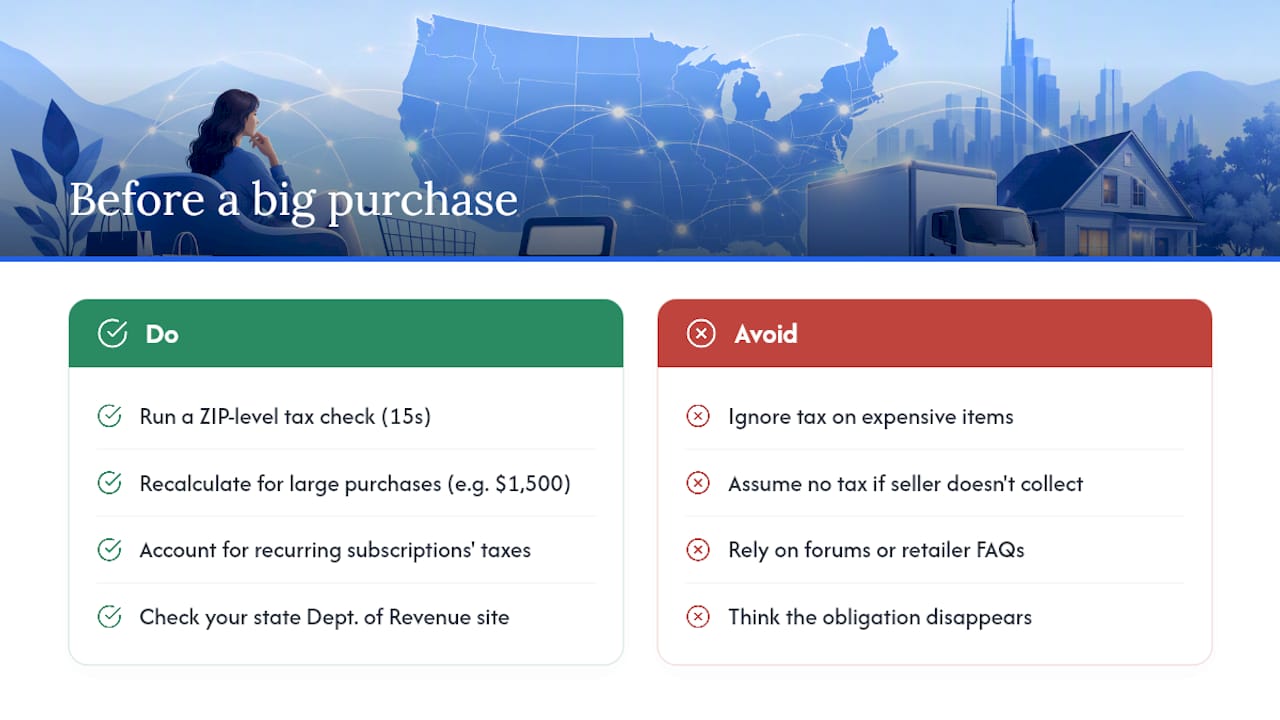
Running a ZIP-level tax check takes fifteen seconds, and it’s the habit that separates shoppers who get surprised at checkout from those who don’t. For a $30 impulse buy, the tax difference between jurisdictions is pocket change. For a $1,500 laptop or a recurring subscription that renews for years, a 2 percent gap in combined rate compounds into real money over time.
Treat any seller who doesn’t collect tax with a little skepticism, not because they’re doing anything wrong, but because the obligation doesn’t vanish. It shifts to you as use tax. When in doubt on a specific rule, your state Department of Revenue’s official page is the source that settles the argument, not a forum post or a retailer’s FAQ.
— Timothy
Start Comparing Total Prices, Not Just Sticker Prices
Most price comparison sites stop at the listed product price and leave you to calculate tax and shipping yourself. Aipricesearch is built to close that gap, aggregating verified US retailers and factory-direct listings so you’re comparing what you’ll actually pay, not just what’s printed on the product page.

Start by searching for the item you want, add your ship-to ZIP, and review tax-inclusive totals across sellers wherever that data is available. If a listing looks too good to be true, run it through the Dropship Detector before you buy, and use the AI Shopping Assistant to build a shopping list and track price drops on items you’re not ready to buy yet. Head to the Aipricesearch homepage to run your first comparison.
Where to Verify Rates Yourself
If a number ever looks off, cross-check it against your state Department of Revenue’s published rate table, that’s the authoritative source. TaxCloud’s real-time calculator is a solid second check for address-level accuracy, and Avalara’s jurisdiction guide explains why district taxes vary so much block to block.
Sources
- Origin-based vs destination-based sales tax | Numeral
- State-by-state guide to marketplace facilitator laws | Avalara
- Should you charge US sales tax based on the billing or shipping address? | Stripe
FAQ
Do You Pay Sales Tax on Online Purchases in 2026?
Yes, in most states. Physical goods shipped to an address in one of the 45 states plus DC that impose sales tax are generally taxed at the combined state and local rate for that delivery address, per Avalara.
How Do I Calculate Sales Tax on an Online Order?
Multiply your taxable subtotal, the item price plus any taxable shipping, by the combined rate for your ship-to address, then divide by 100. Add that result to your subtotal and shipping to get your final total.
Does the Marketplace or the Seller Collect the Tax?
Marketplaces are generally responsible for collecting and remitting tax on behalf of third-party sellers under facilitator laws, according to Avalara’s state-by-state guide. Direct purchases from an independent retailer’s own site depend on whether that retailer has nexus in your state.
Is Shipping Taxable on Online Orders?
It depends on the destination state and how the charge is listed. Some states tax shipping only when it’s bundled into the sale price, while others exempt it if shown as a separate line item, per Stripe.
What If a Retailer Charges the Wrong Sales Tax?
Contact the retailer’s customer service first with your shipping address and ask them to recalculate. If the issue isn’t resolved, your state Department of Revenue can confirm the correct combined rate for your address and advise on next steps.
Does Aipricesearch Show Prices Including Tax?
Aipricesearch ranks listings by total cost, including tax and shipping, when that data is available from the retailer. Compare listings directly on the Aipricesearch homepage to see the most complete total for your ship-to ZIP.
Recommended
- Ai Price Search Vs Camelcamelcamel
- Ai Price Search Vs Shopzilla
- Ai Price Search Vs Pricegrabber
- Ai Price Search Vs Pricerunner
Want to compare offers instantly? Search any product on AI Price Search.
Search a price →