Stop Overpaying: Track iPhone Prices by SKU and Set 8% to 12% Alerts

To know an iPhone’s real market price right now, match the exact SKU (model, storage, carrier status), then compare recent completed sales against current asking prices rather than trusting the listing price alone, since completed sales are the stronger signal. Cross-check that median against inflation-adjusted historical pricing and a tool like AI Price Search, then set an alert at a realistic threshold instead of checking manually every day.
TL;DR:
- Matching the exact SKU and comparing recent completed sales provide a more accurate market value than asking prices alone.
- Analyzing median sale prices and sales volume helps determine how quickly and reliably a device can sell at a given price.
- Prices drop most significantly within the first 60 to 90 days after a new iPhone model launch, especially for older generations.
- Higher storage tiers and unlocked units tend to maintain resale value better, while condition and battery health can reduce worth by up to 20%.
- Using AI Price Search and setting alerts at 8% to 12% below median sales can help track genuine price drops and optimize buying or selling timing.
Table of Contents
- Where to Find Live and Historical iPhone Prices
- How to Estimate Your iPhone’s Resale Value
- What Moves iPhone Value: The Key Drivers to Watch
- How to Set Up Effective Tracking and Alerts
- How AI Price Search Helps Track iPhone Prices
- Author Perspective: When Tracking Pays Off (and When It Doesn’t)
- Try AI Price Search: Set Up a Price Alert Today
- Sources
- FAQ
Where to Find Live and Historical iPhone Prices
Three types of sources cover the full picture, and each one answers a different question.
Marketplace listing pages show what sellers are asking right now. Aggregator trackers like Swappa publish average listing prices and listing counts updated daily, which is useful for spotting a sudden price drop after a new launch. Retailer pages show current sticker price plus trade-in credit, which matters if you’re buying new or trading up. Then there are value-estimation pages such as Techfare, which blend recent sales with active listings to produce a rough market value by model and storage tier.
Here’s the catch almost everyone misses: an asking price and a sale price are not the same number. A seller can list an iPhone 15 Pro at $650 for weeks with zero buyers while the actual completed sales for that same SKU are clearing at $580. Industry analysts specifically flag this gap, noting that buyers who rely on asking prices instead of verified sale data consistently overestimate market value.
When you read a price chart, look for:
- The median sale line, not the average, since one outlier sale can skew an average badly.
- Listing volume, which tells you how many units are actually moving at that price.
- The spread between the lowest and highest active ask, which signals how much room there is to negotiate.
Always match SKU precisely. “iPhone 14” is not a search term. “iPhone 14, 128GB, unlocked, good condition” is.
How to Estimate Your iPhone’s Resale Value
Follow this sequence and you’ll land within a reasonable range almost every time:
- Identify your exact SKU. Model, storage tier, carrier lock status, and whether it’s original retail or refurbished. A locked Verizon iPhone 13 and an unlocked one can differ by $80 or more.
- Pull recent completed sales for that identical SKU. Not asks, sales. Look at the last two to three weeks of data if the model is popular, longer for older or less common configurations.
- Use the median, not the average, as your baseline market value.
- Compare that median to current active listings to gauge liquidity. A tight cluster of asks near the median means a fast, predictable sale. A wide spread means buyers are unsure what it’s worth.
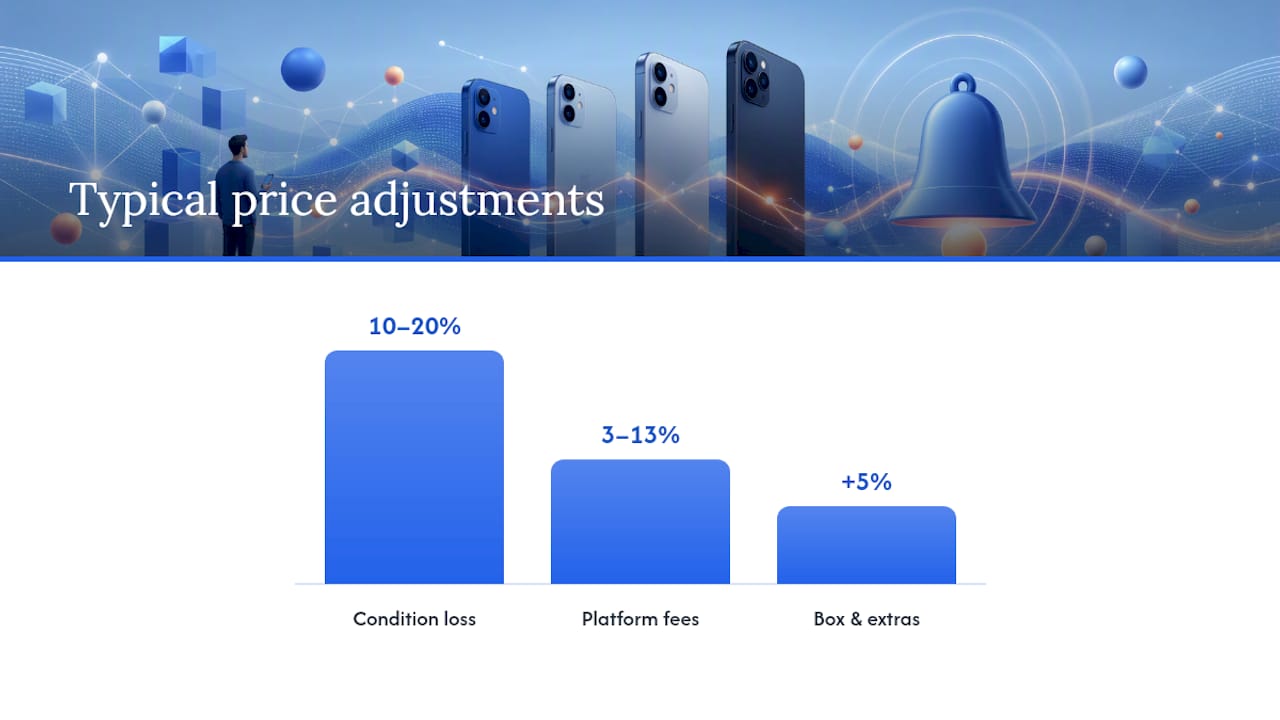
- Adjust for condition and extras. Cracked screen or battery health below 85% typically knocks 10% to 20% off. Original box and accessories can add back 5%.
Pro Tip: If you need cash fast, price at or slightly under the completed-sales median. Chasing the top of the ask range usually means your listing sits for weeks while cheaper, identical units sell around you.
Fee math matters too. Marketplace and payment processing fees typically run 3% to 13% depending on platform, so subtract that before comparing net proceeds across venues.
What Moves iPhone Value: The Key Drivers to Watch
Price behavior isn’t random. A handful of forces explain almost every swing you’ll see in a price chart.
New-model launches hit hardest. When Apple releases a new lineup each fall, the prior generation typically drops fastest in the first 60 to 90 days after announcement, then levels off. Buyers chasing the newest camera or chip abandon last year’s model, and resale prices adjust immediately.
Beyond launch timing, watch these:
- Storage tier stability. Higher storage models (256GB and up) tend to hold value better because demand for them stays consistent across buyer types.
- Condition and battery health. A phone below 80% battery health sells for meaningfully less regardless of cosmetic condition.
- Carrier locking. Unlocked units command a premium because they work with any carrier, including prepaid.
- Seasonal promotions and trade-in programs. Retailer trade-in bonuses around back-to-school and the holidays can temporarily flood the secondhand market and soften prices.
Here’s a useful anchor point when new prices seem high: inflation-adjusted analysis shows iPhone median launch prices have stayed roughly in the $500 to $700 band since 2012. That stability means a “shocking” launch price is often just inflation catching up, not Apple pushing margins.
How to Set Up Effective Tracking and Alerts
Build a saved search around these exact fields: model name, storage capacity, carrier status (locked or unlocked), and condition grade. Skip any of those and you’ll get alerts full of noise.
- Create the saved search with all four fields locked in, not just the model name.
- Choose your alert type. A percentage-drop alert (notify me at 10% below current median) works well for patient buyers. An absolute price target works better if you have a hard budget.
- Set your monitoring cadence based on model age. Current-generation models move fast, check weekly. Models two or more years old move slowly, monthly checks are enough.
- Verify any price signal before acting. Check seller rating, return policy, and whether recent completed sales for similar SKUs support the price you’re seeing.
- Set both a buy target and a sell target using the completed-sales median as your center point, adjusting a few percent in either direction based on listing spread.
Pro Tip: Don’t set your alert threshold at the absolute lowest price you’ve ever seen. That price was likely a distressed sale, and waiting for it to repeat can cost you months of missed opportunities.
How AI Price Search Helps Track iPhone Prices
Running the SKU-first workflow manually across multiple retailer sites and marketplaces gets tedious fast. AI Price Search was built to compress that into one search.
The tool compares prices across various retailers and sources, flags dropship markups on inflated reseller listings, and lets you set price-tracking alerts tied to a specific product rather than a vague category.
Reported average savings have been noted by users this month, based on price comparisons.
To apply the workflow from this article:
- Search your exact SKU (model, storage, carrier status).
- Enable a price alert at your target threshold.
- Use the comparison results to sanity-check any completed-sales median you found elsewhere.
- Confirm seller reliability through the dropship detector before committing to any reseller listing.
Always verify a seller’s return policy separately. No price tool, including this one, replaces reading the fine print before you buy.
Author Perspective: When Tracking Pays Off (and When It Doesn’t)
Active tracking earns its keep on high-demand, high-margin models: a launch-year Pro Max, a storage tier everyone wants. Patience there can save real money.
For low-margin, older models or when you need a device this week, tracking becomes a time sink with a small payoff. My rule of thumb: if the potential savings are under $30, buy now. If they’re over $75 on a model with real price volatility, it’s worth a week of watching.
— Timothy
Try AI Price Search: Set Up a Price Alert Today
AI Price Search gives you one place to compare verified retailer and marketplace offers for the exact iPhone SKU you’re watching, instead of tab-hopping between five sites.

Set an alert at 8% to 12% below the current median for your model. That range tends to reflect genuine price drops rather than noise, and you’ll get notified the moment a verified listing hits it. Before you commit to any reseller offer, run it through the dropship detector to rule out inflated markups. Start your free comparison and alert setup at AI Price Search and stop refreshing five browser tabs a day.
Sources
- Apple surprises with iPhone duo pricing — Counterpoint Research
- iPhone Pricing: Exceptional Performance at a Steady Cost — Asymco
- Current prices — Swappa
FAQ
How Do I Check Current iPhone Prices?
Match your exact model, storage, and carrier status, then compare active listings on retailer and marketplace sites against recent completed sales for that same SKU rather than relying on one asking price.
Why Is the iPhone 16 So Cheap Now?
Prices on last-generation models drop after a new lineup launches because buyer demand shifts to the newest release, and that depreciation typically accelerates in the first 60 to 90 days post-announcement.
How Can I Check How Much My iPhone Is Worth?
Pull the median of recent completed sales for your exact SKU, then adjust down 10% to 20% for below-85% battery health or cosmetic damage, and account for marketplace fees before calculating net proceeds.
How Much Will an iPhone 17 Cost?
Inflation-adjusted history suggests new iPhone launch prices will likely stay near the $500 to $700 band seen since 2012, though exact new-model pricing depends on Apple’s announcement and isn’t set until launch.
Recommended
- 225 Product Searches Analyzed Amazon Leads As Cheapest Retailer In 51 Of Cases
- Amazon Vs Walmart Price Leadership Across 182 Weekly Searches
- August Price Tracker Amazon Leads In Value Across 153 Shopper Queries
- Retailer Price Wars Aliexpress And Amazon Split The Lead In 184 Consumer Searches
Want to compare offers instantly? Search any product on AI Price Search.
Search a price →