10 Minute Checklist: Verify an Online Seller, Start with Price Search

Before you pay: check the seller’s identity, use a protected payment method, and scan recent reviews for complaint patterns. Doing those three things catches most scams before they cost you anything. The FTC recommends keeping records of every purchase and trying the seller directly before escalating, and a decent site checker can flag the rest in seconds.
TL;DR:
- Verifying if a seller’s domain is recent, using a WHOIS lookup, can reveal red flags like new registrations for luxury items at suspiciously low prices.
- Checking account age, transaction history, and review patterns helps distinguish legitimate sellers from those with fabricated or manipulated feedback.
- Using protected payment methods such as credit cards and PayPal ensures dispute options, unlike gift cards, wire transfers, or cryptocurrencies that offer no recourse.
- Conducting reverse image searches on listing photos and cross-referencing prices across verified retailers helps detect dropship scams and stolen images.
- Combining multiple verification checks, including review analysis and domain trustworthiness tools, increases the likelihood of avoiding e-commerce fraud.
Table of Contents
- Verify Online Seller Legitimacy: The 10-Minute Checklist
- How to Verify Seller Identity and Contact Details
- Spotting Fake Reviews and Manipulated Listings
- Payment Methods That Actually Protect You
- What to Save and How to Report a Bad Seller
- Tools That Speed Up Seller Verification
- How AI Price Search Approaches Seller Verification
- The Checklist Beats the Instinct
- Add a Price Check to Your Verification Routine
- Sources
- FAQ
Verify Online Seller Legitimacy: The 10-Minute Checklist
You don’t need an hour to protect yourself from a bad purchase. Most scam listings fall apart under five minutes of scrutiny, because the people running them are optimizing for volume, not for surviving a close look. Here’s the order that catches the most problems the fastest.
- Check the URL and domain age. Confirm the site uses HTTPS, then run the domain through a WHOIS lookup to see how old it is. A very recently registered domain selling “luxury” watches at a dramatically reduced price is a strong red flag.
- Look at the seller profile. On marketplaces, check account age, total transaction count, and whether the item is “sold by” the platform or a third party.
- Scan reviews for bursts and complaints. A steady trickle of reviews over years reads differently than 400 five-star reviews posted in one week.
- Pick a protected payment method. Credit cards and PayPal both offer dispute processes. Gift cards, wire transfers, and crypto payments do not.
- Read the returns and shipping policy before adding to cart, not after the item arrives broken.
- Keep all communication on-platform. A seller who pushes you to email or text outside the marketplace is trying to avoid its buyer protections.
- Count your red flags. One odd detail is worth a second look. Three or more means walk away and buy from someone else.
None of these steps requires special software, though a price comparison tool can speed up step one by showing you whether a “deal” price is realistic across other retailers before you dig into the seller’s history at all.
How to Verify Seller Identity and Contact Details
A legitimate seller leaves a paper trail. A scam operation usually leaves gaps where that trail should be, and finding the gap is faster than most people expect.
Start with the seller’s profile page. Account age, order history, and the number of completed sales tell you more than a star rating ever will. Pay attention to labels like “sold by” versus “fulfilled by,” since a marketplace’s own buyer protections often don’t extend the same way to third-party sellers using its warehouse.
From there, run the seller’s business name, username, and any listed email through a search engine, adding terms like “scam” or “complaints” to the query. Real complaint threads tend to surface fast if a seller has burned enough customers. If they claim to operate as a registered business, check your state’s secretary of state business registry for a matching entity name.
WHOIS data matters here too. A domain hiding behind full privacy masking isn’t automatically dishonest, but combined with a recent registration date and no verifiable street address, it’s a pattern worth taking seriously.
Watch for these specific mismatches:
- A shipping address that doesn’t match the “About Us” page location
- Requests to move the conversation to email, WhatsApp, or text before you’ve paid
- A brand name on the listing that doesn’t match the seller name on the checkout page
- Contact forms that never generate an auto-reply or confirmation number
Pro Tip: If a seller only offers a contact form and no phone number or physical address anywhere on the site, treat that as one strike, not a dealbreaker on its own. Add a second check, like a reverse-image search on the product photos, before deciding.
Spotting Fake Reviews and Manipulated Listings
Star averages lie. A 4.6 rating built on 40 lukewarm reviews spread over three years tells a different story than a 4.8 built on 300 identical five-star reviews posted last Tuesday. Reviewers who genuinely bought a product tend to write with small inconsistencies, specific gripes, and photos that don’t look staged. Fake review farms tend to write in bursts, reuse phrasing, and pile on generic praise like “great product, fast shipping” with no detail about the actual item.
Sustained review history matters more than volume. A multi-signal approach that weighs review timing alongside identity checks and listing quality catches far more fraud than trusting any single number.
The listing photos deserve their own check. Run a reverse image search on the main product photo. If the exact same image shows up on ten unrelated stores with different brand names slapped on, you’ve found a dropship scam or a stolen-photo listing, not a real inventory.
Legitimate listings also tend to include specifics: model numbers, exact measurements, material composition, sometimes a serial number range. Vague copy that could describe a dozen different products is a shortcut scammers take because writing real detail requires actually owning the product.
Give more weight to:
- Independent forums and third-party review sites over on-site testimonials
- Reviews mentioning specific delivery times, packaging, or defects
- Photos in reviews that look like they were taken in a normal home, not a studio
- Consumer complaint boards, which surface patterns a single storefront will never show you
E-commerce fraud remains a large enough problem that industry trackers treat it as a standing category of financial crime, not a rare event. That’s the backdrop that makes a five-minute review check worth the time.
Payment Methods That Actually Protect You
The payment method you choose determines whether a bad purchase is a minor annoyance or a total loss. Credit cards give you a formal chargeback process if an item never arrives or turns out to be counterfeit. PayPal and similar services layer on their own buyer protection and dispute resolution on top of that. Both routes give you a third party with leverage over the seller, which is the entire point.
Avoid these payment methods when buying from anyone you haven’t verified:
- Gift cards — once the code is used, the money is gone, and no bank can reverse it.
- Wire transfers — instant, irreversible, and a favorite of scam operations for exactly that reason.
- Direct cryptocurrency payments — no dispute mechanism, no chargeback, no recourse.
- Peer-to-peer payment apps sent as “friends and family” — this setting strips out the buyer protection those apps otherwise offer.
Keep every message and payment inside the platform’s own system whenever possible. A dispute is far easier to win when the marketplace can see the entire conversation and transaction history itself, rather than relying on your screenshots alone.
If you’ve already sent payment through an unprotected method and something feels wrong, don’t wait to see if the item shows up. Document everything immediately and call your bank or payment provider the same day. Speed matters more with wire transfers and gift cards than with almost any other kind of dispute, because the window to reverse anything closes fast.
What to Save and How to Report a Bad Seller
Save your paper trail before you need it, not after. Screenshots of the listing, the order confirmation email, tracking numbers, and every message exchanged with the seller all matter if a dispute goes sideways.
Most marketplaces have a built-in dispute process, and typical response windows run anywhere from a few days to about two weeks depending on the platform and the type of claim. If the seller doesn’t respond or the platform sides against you unfairly, you have two more paths:
- File a chargeback directly with your credit card issuer
- Report the seller at Reportfraud, the FTC’s official consumer complaint portal
The FTC’s own guidance recommends trying to resolve the issue with the seller first, then escalating if that goes nowhere. For anything involving a large sum of money or a pattern that looks like organized fraud rather than a one-off bad seller, contacting local law enforcement is worth the extra step.
Tools That Speed Up Seller Verification
Manual checks work, but a handful of tools cut the time down considerably. None of them replace judgment, and each one is best treated as one data point among several rather than a final verdict.
- Google Safe Browsing flags known malware and phishing domains before you even click through.
- ScamAdviser and the F-Secure Online Shopping Checker score a domain’s trustworthiness using registration age, hosting history, and known scam databases.
- Google Images or TinEye for reverse-searching listing photos. A match on dozens of unrelated stores is close to a confirmed red flag.
- Independent review aggregators and consumer-advice sites, which surface complaint patterns a storefront will never show on its own product page.
The right approach layers two or three of these together instead of trusting one score. A seven-step verification workflow that combines account age, reverse-image search, and a request for video proof on high-value items catches far more scams than any single check run alone.
How AI Price Search Approaches Seller Verification
Checking a price across retailers is itself a verification step most shoppers skip. A price comparison tool can flag those gaps automatically by cross-checking listings against verified retailers and sources so an unrealistic price gets noticed before checkout instead of after a dispute. It’s one more signal, not a replacement for checking reviews or contact details yourself.
The Checklist Beats the Instinct
Most advice on this topic tells you to “trust your gut” about a seller, and that’s backwards. Gut instinct is exactly what scam listings are engineered to defeat, with polished photos, inflated review counts, and urgency language designed to short circuit the second look you’d otherwise take. The shoppers who get burned aren’t usually careless. They’re just moving fast, and fast is what fraud relies on.
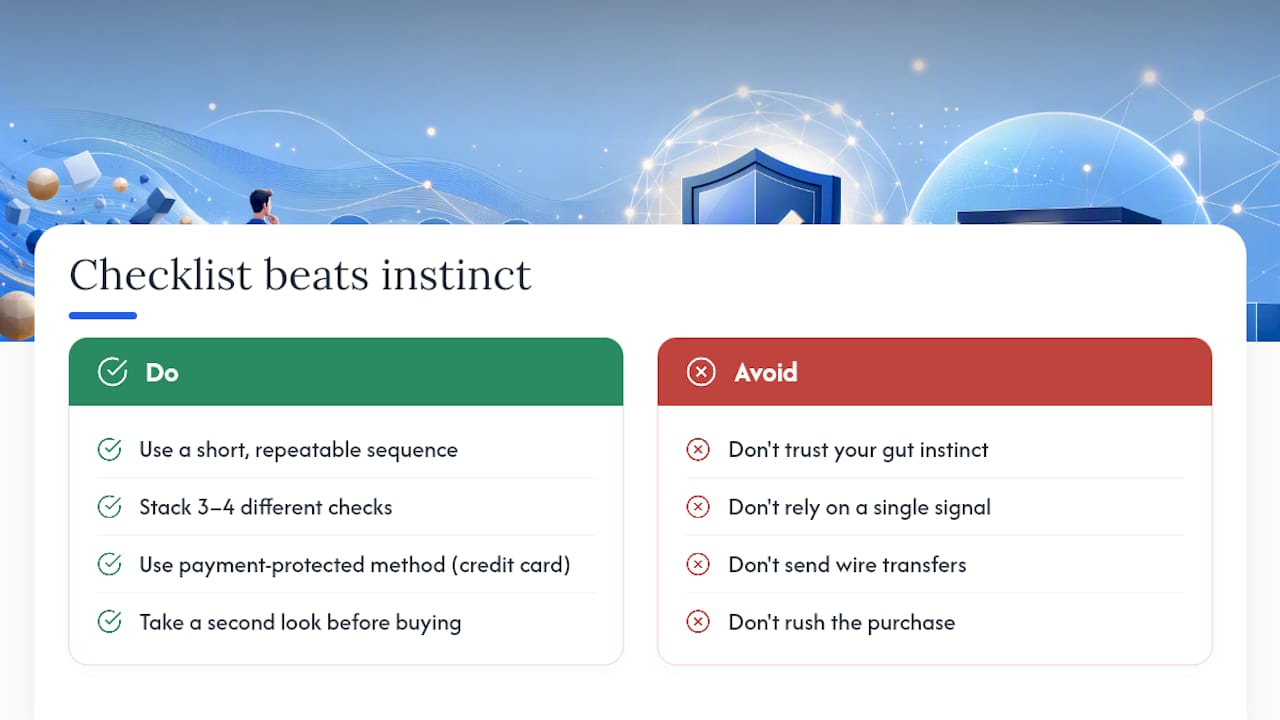
What the evidence actually supports is a short, repeatable sequence over any single “trust signal.” No one review score, badge, or domain age check catches everything on its own. Stack three or four together, though, and the odds shift hard in your favor. That’s the real lesson buried in every seller-verification guide worth reading: breadth beats depth. Five quick checks across different angles will outperform one deep dive into a single data point almost every time.
Prioritize payment protection first if you only do one thing differently starting today. A credit card dispute can undo a mistake. A wire transfer to a scam seller usually can’t.
— Timothy
Add a Price Check to Your Verification Routine
A suspiciously low price is often the first clue something’s off with a seller, and the tool catches that clue before you’ve even clicked through to checkout by comparing prices across verified retailers and sources, and its detection features flag listings priced well outside what legitimate sellers are charging for the same item.
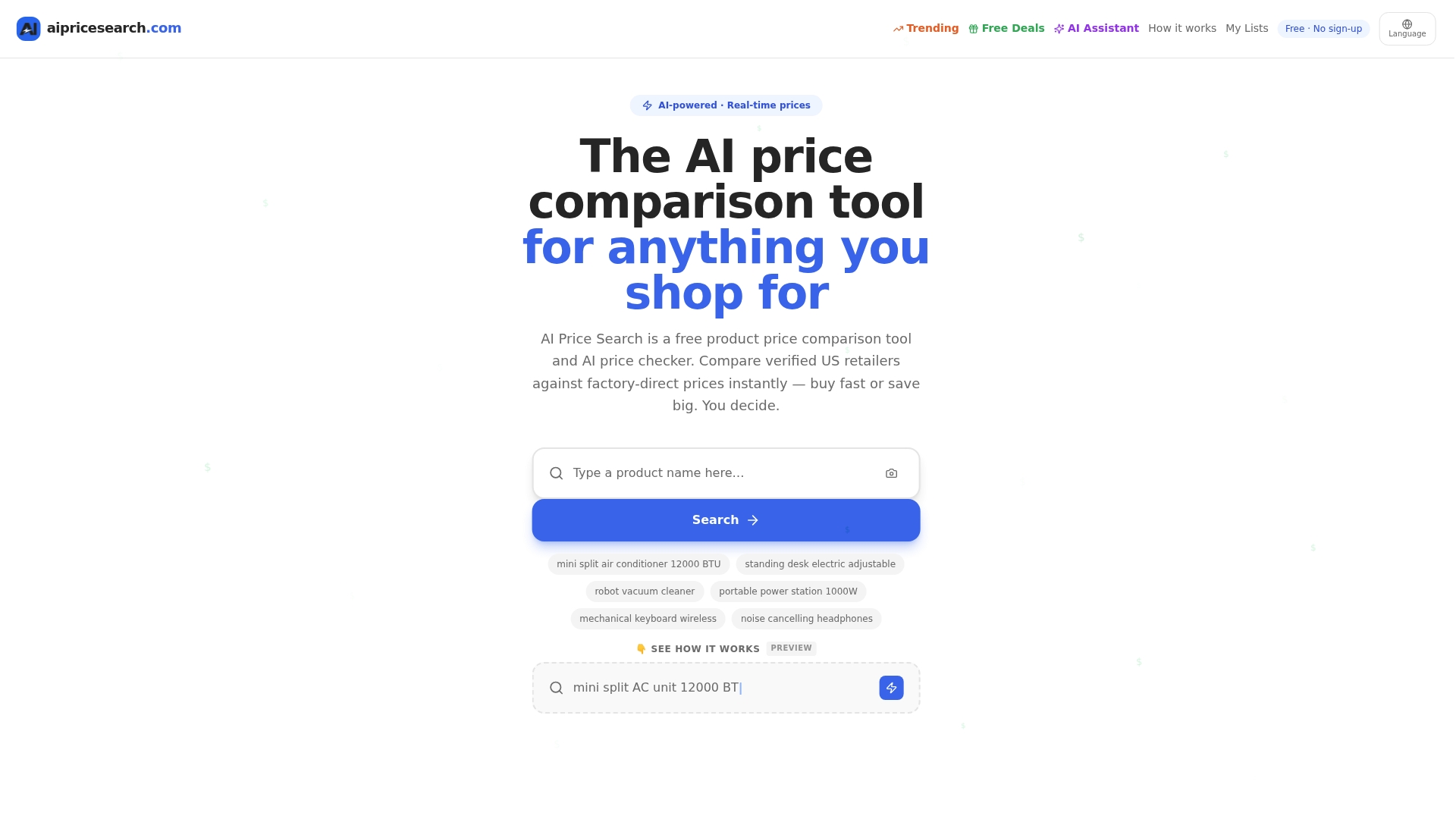
Run the same product through Aipricesearch first. If every verified retailer is charging roughly the same price and this one outlier isn’t, that’s your cue to run the rest of the checklist, WHOIS lookup, review scan, reverse-image search, before you type in a card number. Start comparing prices at Aipricesearch and treat the results as your first red flag detector, not your last line of defense.
Sources
- Online shopping | Consumer Advice
- How to Verify an Online Seller’s Legitimacy Before You Buy
- E-commerce fraud — Statista topic page
FAQ
How Do I Know if an Online Seller Is Legit?
Check the seller’s profile age and transaction history, scan reviews for recent complaint patterns, confirm HTTPS and domain age through a WHOIS lookup, and pay only through a credit card or PayPal.
How Can I Tell if an Online Shop Is Legit?
Look for a verifiable street address and phone number, clear return and shipping policies, and consistent reviews across independent sites, not just the shop’s own testimonials.
How Do I Verify a Marketplace Seller on Sites Like eBay or Etsy?
Check the “sold by” label to see if the platform or a third party fulfills the order, review the seller’s account age and feedback score, and avoid any request to pay or communicate off-platform.
Can Price Comparison Tools Help Confirm a Seller Is Trustworthy?
Yes. A price comparison tool can flag prices that fall far below what verified retailers charge for the same product, which often points to a dropship scam or misrepresented listing before you commit to buying.
What’s the Fastest Way to Check if Someone Is a Real Seller Online?
Search their business name and username alongside terms like “scam” or “complaints,” run a reverse-image search on their product photos, and check how long their domain has been registered.
Recommended
- Yahoo Shopping Comparison
- Google Shopping Comparison
- Ai Price Search Vs Shopzilla
- Ai Price Search Vs Pricegrabber
Want to compare offers instantly? Search any product on AI Price Search.
Search a price →