Five Minute Fake Review Check: 10 Red Flags and AI Aware Price Test

The fastest reliable method: scan the top reviews for three red flags (timing clusters, repeated phrasing, and thin reviewer profiles), then verify one suspicious review by clicking the reviewer’s name and cross-checking it on another site. If you’re still unsure, run the listing through a review-analyzer as a tie-breaker. No single check is definitive, which is why Consumer Reports recommends combining several, and a price-comparison tool can add a useful seller-reliability signal on top.
TL;DR:
- Most fake reviews appear in timing clusters, use repeated phrasing, and come from thin or suspicious reviewer profiles.
- Verifying reviewer profiles and cross-checking reviews on multiple sites can help distinguish genuine feedback from fakes.
- AI review analyzers are useful but limited, as platform data like purchase verification and review timing remain inaccessible to third-party tools.
- Generative AI-written reviews are becoming more polished and harder to identify, emphasizing the importance of metadata and review pattern analysis.
- For purchases under $30, quick red flag checks suffice, while more significant investments warrant comprehensive review and seller verification.
Table of Contents
- High-Yield Checklist: 10 Red Flags That Usually Mean a Review Is Suspect
- Step-by-Step Verification: A Five-Minute Process You Can Run on Any Listing
- How Review-Checker Tools and Extensions Work, and Where They Fall Short
- Why Generative AI Makes Fake Reviews Harder to Spot
- When It’s Worth Digging, and When It Isn’t
- A Second Line of Defense: Checking the Seller, Not Just the Reviews
- Where to Verify This Yourself
- Sources
High-Yield Checklist: 10 Red Flags That Usually Mean a Review Is Suspect
Fake reviews tend to cluster around a handful of tells. You don’t need a forensic background to catch most of them. You need to know where to look and what patterns actually matter.
Here’s the shortlist that catches the majority of fakes without much effort:
- Timing clusters: a burst of five-star reviews posted within days of each other, especially right after launch.
- Repeated phrasing: several reviews using near-identical sentences, product descriptions, or unusual adjectives (“game-changing,” “life-saving”) that read like marketing copy.
- Thin reviewer profiles: accounts with just one review ever, no photo, and a generic name like “Amazon Customer” or a string of numbers.
- Cross-category reviewers: a profile that reviewed a garden hose, a phone case, and a mattress topper, all five stars, all in the same week.
- Missing Verified Purchase badges: a pattern of unverified purchases on an otherwise popular listing is worth a second look.
- Inconsistent product details: reviewers describing a color, size, or feature the listing doesn’t actually offer.
- Extreme rating skew: almost no 2 or 3 star reviews, just a wall of 5s and a scattering of angry 1s.
- Suspicious reviewer locations: several “verified” reviewers all logged from the same unlikely region for a niche product.
- Scene-setting language: reviews that open with a personal backstory before ever mentioning the product. Cornell researchers found this kind of narrative padding is one of the more reliable textual markers of fabricated reviews.
- Photos that don’t match: stock-looking images, or the same photo appearing under multiple reviewer names.
Pro Tip: Filter reviews to “Most Recent” first, not “Most Helpful.” Manipulated listings often get flooded early, so the newest reviews tend to be more honest once the initial push fades.
Step-by-Step Verification: A Five-Minute Process You Can Run on Any Listing
Spotting a red flag is only half the job. Turning that suspicion into an actual buy or skip decision takes a short, repeatable process.
- Confirm the exact product and variant. Reviews sometimes migrate between merged listings, so a glowing review might be describing a different color, size, or even a completely different generation of the product. Check the SKU or model number against what’s in the review text.
- Click into two or three reviewer profiles. Look at their review history. A reviewer with 40 five-star reviews across unrelated categories, all posted within the same month, is a strong sign of a paid review network rather than an organic customer.
- Filter to “Most Recent” and “Verified Purchase.” Save or screenshot anything that still looks off. This gives you a clean, undiluted read on how the product is performing right now, not six months ago when the listing may have been juiced.
- Copy a suspicious sentence and search it. Paste an unusual phrase from a review into Google in quotation marks. If the exact wording shows up on other unrelated products or on review-farm forums, you’ve found a template, not a customer.
- Cross-check on another retailer. If the same product is sold elsewhere, compare rating patterns on other retailers. A 4.8 average on one site and a 3.2 average everywhere else tells you something.
- Decide and document. If you buy, keep the flagged reviews on file. If the product disappoints in a way the fake reviews masked, you’ll have a record to support a refund request or a report to the platform.
This whole process takes less time than picking a font for a resume, and it turns a gut feeling into something you can act on with actual confidence.
How Review-Checker Tools and Extensions Work, and Where They Fall Short
Third-party review analyzers score a listing by scanning the same kinds of patterns covered above, just faster and at scale. Most of them lean on a mix of:
- Linguistic analysis: flagging repeated phrasing, unnatural sentence structures, or clusters of generic superlatives.
- Reviewer network graphs: mapping which accounts review together, how often, and whether they show up across suspiciously similar product categories.
- Timing analysis: charting review volume over time to catch unnatural spikes.
- AI-text detection: estimating whether a review’s phrasing matches patterns typical of generated text rather than a real customer voice.
- Verified Purchase weighting: discounting or excluding unverified reviews from the overall score.
These tools are genuinely useful as a first pass, but they operate with a real handicap: they can’t see what the platform sees. Amazon has said it uses machine learning and graph-analysis techniques tied to login behavior, device fingerprints, and purchase confirmation data that no browser extension can access. That’s a big part of why a listing might look “clean” to a third-party tool and still get flagged internally, or vice versa.
There’s also a growing false-positive problem. As more legitimate shoppers use AI tools to help draft a review, or simply write in a polished, formal style, analyzers built to catch AI-generated text can flag perfectly real feedback as suspicious. WIRED’s reporting on review-checker tools notes that these apps aggregate useful signals but are limited by the platform metadata they can’t access, and heuristics alone will occasionally get it wrong in both directions.
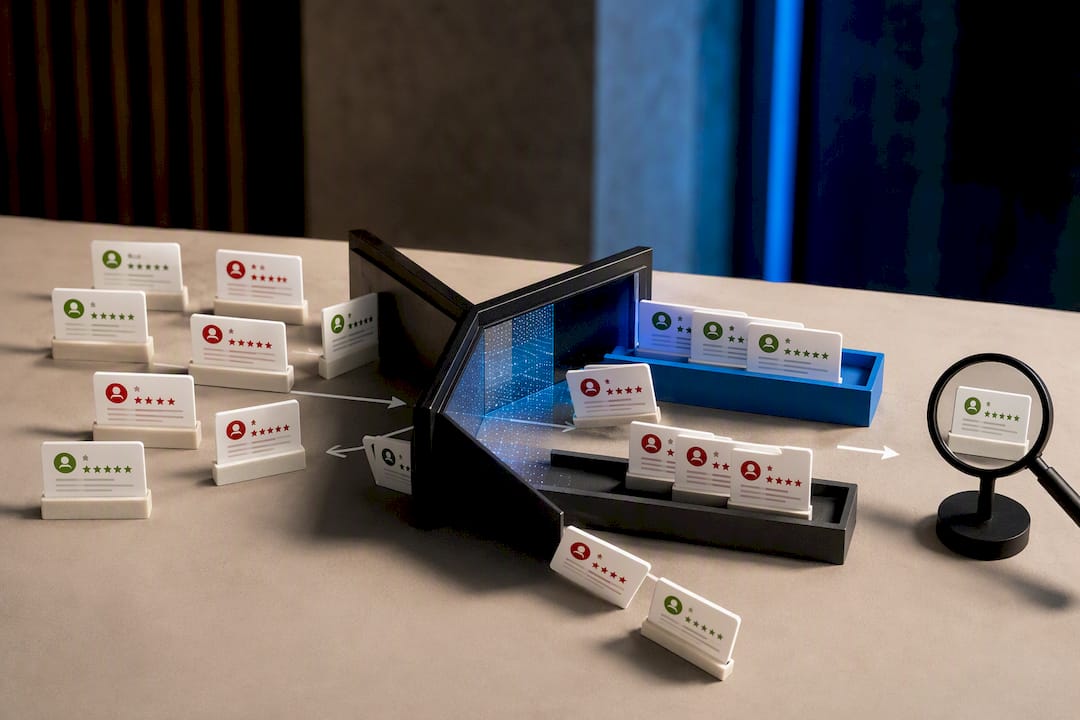
Treat a review-analyzer score the way you’d treat a credit score: informative, worth checking, but not the final word. Run the tool, then actually read the two or three reviews it flags as most suspicious. If they hold up to your own eyeball test after that, adjust your confidence up or down and make the call yourself.
Why Generative AI Makes Fake Reviews Harder to Spot
Manual detection used to lean heavily on spotting clumsy, obviously fake-sounding text. That advantage is fading fast. AP News reporting on generative AI and fake reviews found that AI-written reviews tend to be longer, more polished, and stuffed with the kind of vague, glowing descriptors that used to be a giveaway, except now they read smoothly enough to fool a casual scan.
Some industry analyses cited by Consumer Reports put the share of inauthentic reviews in certain Amazon categories in the 30–42% range, a reminder that “mostly positive” doesn’t always mean “mostly honest.”
That shift changes what’s actually worth your attention. Surface polish, once a red flag when it was too smooth or too generic, is now a weaker signal because AI can produce fluent prose on command. What’s harder to fake is metadata: the timing graph of when reviews landed, the network of accounts posting them, and whether the same claims show up verbatim across unrelated listings.
Regulators are responding to the same trend. The FTC’s Bureau of Consumer Protection has pursued rulemaking and enforcement specifically targeting fake and paid reviews, and offers a reporting portal for consumers who spot suspected manipulation. If you catch a pattern that looks organized rather than incidental, that’s the place to send it.
Practically, this means leaning harder on the checks a generative model can’t fake: cross-site corroboration, reviewer purchase history, and posting-time clustering. Polish is cheap now. A believable pattern across independent sources still isn’t.
When It’s Worth Digging, and When It Isn’t
Match your effort to the price tag. For anything under $30, a 60-second scan for the obvious red flags is enough. For $100 and up, run the full five-minute check before you buy. For a major purchase, appliances, electronics, anything four figures, cross-check ratings across at least two retailers and read the one-star reviews closely.
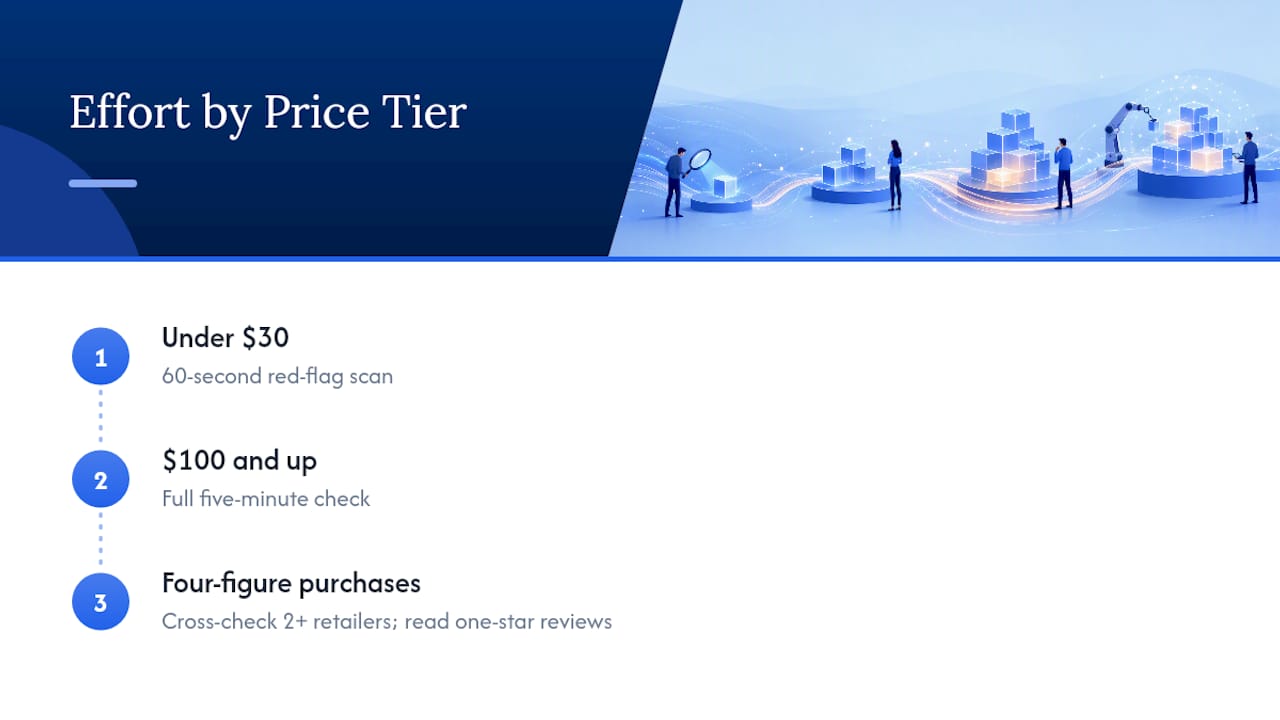
Most shoppers over-invest time on cheap impulse buys and under-invest on the purchases that actually carry risk. Default to the quick scan, escalate by price, and skip the deep dive on anything you could replace without a second thought. If you want the full breakdown of how price patterns across retailers can also flag risky sellers, that’s worth a separate read.
A Second Line of Defense: Checking the Seller, Not Just the Reviews
Fake reviews are usually a symptom of a bigger problem: a seller cutting corners somewhere, whether that’s a listing padded with paid reviews or a product quietly relabeled and marked up through a dropship pipeline. Reviews tell you what past buyers experienced. Price and seller data tell you something reviews can’t: whether the listing itself looks legitimate in the first place.
Aipricesearch approaches this from the price side. The Dropship Detector flags listings that show classic markup patterns, the kind you see when a seller is reselling a factory-direct item at an inflated price with a suspiciously thin review history to match. An AI-assisted shopping tool pulls verified pricing from multiple retailers so you can see whether a “deal” price actually lines up with what the rest of the market is charging, another signal that a listing might be cutting corners to move inventory fast.
A simple three-step workflow: check the price against other retailers first, check the seller’s markup pattern second, then apply the review checklist above as your final filter. If a listing fails two out of three, walk away. Start with the AIShopping Assistant on your next purchase and see how the seller signals stack up before you trust the star rating alone.
Where to Verify This Yourself
- FTC guidance on evaluating online reviews covers verified-purchase checks and reviewer history.
- Consumer Reports’ overview of fake reviews breaks down practical detection tips.
- Cornell’s opinion-spam research and Amazon’s own statement on AI-based detection add platform-level context.
Sources
- How to Spot Fake Online Reviews - Consumer Reports
- FTC Bureau of Consumer Protection
- How Amazon is using AI to detect fake product reviews
Recommended
- 225 Product Searches Analyzed Amazon Leads As Cheapest Retailer In 51 Of Cases
- Amazon Vs Walmart Price Leadership Across 182 Weekly Searches
- August Price Tracker Amazon Leads In Value Across 153 Shopper Queries
- Retailer Price Wars Aliexpress And Amazon Split The Lead In 184 Consumer Searches
Want to compare offers instantly? Search any product on AI Price Search.
Search a price →