Total Cost AI Proves the Real Online Lowest Price Guarantee

A genuine lowest price guarantee online isn’t a store promising to match a competitor’s ad. It’s an AI tool that scans verified retailers and factory-direct sellers, adds up the real total cost (item, shipping, tax) and alerts you when that number drops. Aipricesearch runs on exactly this model, comparing verified sellers so you see the true lowest price before you click buy.
TL;DR:
- Buyers should ensure price comparison tools include shipping, taxes, and return risks in their calculations, as these factors often reverse which seller is cheapest.
- Verifying seller authenticity and detecting dropshipping listings prevent overpaying on markup-heavy or unverified sellers.
- Automated AI-based price monitoring regularly tracks verified retailers, catching price drops and flash sales that manual checks might miss.
- Comparing total costs, including bundle size and condition differences, is crucial for an accurate lowest-price determination.
Table of Contents
- How Does an AI Price Comparison Tool Actually Work?
- Why Shipping, Tax, and Return Risk Change the Real Lowest Price
- What Should You Look for in a Price-Tracking Tool?
- How Do You Use AI Price Search to Lock In the Lowest Verified Price?
- Why Automated Price Monitoring Beats Manual Checking
- Start Comparing Verified Prices With Aipricesearch
- Sources
How Does an AI Price Comparison Tool Actually Work?
An AI price-comparison engine pulls listings from retailer sites and factory-direct marketplaces using scraping tools and retailer APIs, then matches products across sellers using identifiers like UPCs and model numbers. That matching step matters more than people realize. Two listings can look identical and still be different products, different bundle sizes, or different conditions, and barcode-level matching is what keeps the comparison honest.
Raw price data alone doesn’t tell you much. The tool has to normalize it:
- Add shipping cost, since many price feeds capture the listed price but skip shipping entirely
- Apply your local sales tax
- Break out bundle pricing so a “$45 two-pack” isn’t compared against a single unit at $30
- Flag condition differences (new, refurbished, open-box) that change the real value
Once prices are normalized, the system needs to keep checking. AI agents built for this monitor competitor pages on a set schedule rather than waiting for someone to look manually, which is how they catch price drops and flash sales that a person checking once a day would miss. When a tracked item drops below your threshold, the alert fires through push notification, email, or a browser extension, depending on what you’ve set up.
Seller verification is the piece shoppers skip and shouldn’t. A price that looks lowest because it’s coming from an unverified dropshipper carrying a markup isn’t actually the lowest price. It’s a risk wearing a discount.
Why Shipping, Tax, and Return Risk Change the Real Lowest Price
The sticker price on a product page is often not the number that matters. CEPR research on platform retail competition found that including shipping costs can flip which seller actually comes out cheaper, because the sign of the average price gap reverses once shipping enters the equation. A retailer with a higher sticker price but flat-rate or free shipping frequently wins on total cost against a lower sticker price with a $9.99 shipping charge tacked on at checkout.
Part of the problem is where the data comes from. Standard price collections typically log the listed price at the product level and exclude shipping, so anyone comparing raw listed prices is comparing incomplete numbers.
Here’s a practical framework for getting to the real number:
- Start with the listed price.
- Add shipping, even if it’s labeled “free” (check whether that’s baked into a higher item price).
- Add your applicable sales tax.
- Add any marketplace or payment fee shown at checkout.
- Estimate a return-risk cost. Used, refurbished, and local-pickup listings carry higher odds of a return or a wasted trip, so weight them accordingly.
A Vary uses this exact stepwise approach: listed price plus shipping plus tax plus fees plus estimated return-risk cost equals your adjusted total. Rank offers by that number, not the sticker price.
Statistic to remember: shipping inclusion is common enough to change the winning seller in real comparisons, which is why any price-checking method that ignores it is guessing, not guaranteeing.
What Should You Look for in a Price-Tracking Tool?
Not every price tracker earns your trust. Before you rely on one, check it against a short list of criteria that actually predict whether it finds the real lowest price.
- Coverage breadth: Does it pull from a wide mix of retailers and factory-direct sources, or just a handful of big names?
- Total-cost normalization: Does it clearly show whether shipping and tax are included in the price you’re seeing, or is that hidden until checkout?
- Alert quality: Are drop alerts based on accurate historical price data, or do you get flooded with false positives?
- Seller verification and dropship detection: Does the tool flag markup-heavy dropship listings, or treat every seller as equal?
- Usability features: Image search, shareable smart lists, and a browser extension all matter if you shop often and don’t want to retype product names.
- Data practices: Does it ask for more personal information than it needs to track a price?
Bundles and unit sizes trip up more shoppers than outright scams do. A normalization-first approach separates bundle value and unit size before ranking anything, so you’re never comparing a 12-pack against a single unit and thinking you found a steal.
Pro Tip: Before trusting any “lowest price” badge, check whether the tool shows shipping and tax in the displayed total or only reveals them at checkout. That single detail separates a real comparison tool from a glorified price list.
How Do You Use AI Price Search to Lock In the Lowest Verified Price?
Getting started takes under a minute, and the workflow is built around the same total-cost logic covered above.
- Paste a product URL or use image search if you don’t have a link, just a photo of the item.
- Review the normalized total across verified retailers and factory-direct sellers, including estimated shipping and tax.
- Set a price-drop threshold and pick your alert channel, whether that’s email, push notification, or the browser extension.
- Build a smart shopping list for items you’re tracking over time, and share it if you’re shopping with someone else.
- Before you check out, do a quick sanity check: confirm the final shipping charge and tax match what the tool showed you.
That last step matters. Retailers occasionally change shipping thresholds or run out of stock at the listed price, so a five-second checkout glance protects the savings you just found. Design practices for AI price tools consistently point to easy entry points like image search and URL paste as what actually gets people to use these tools regularly instead of abandoning them after one search.
Why Automated Price Monitoring Beats Manual Checking
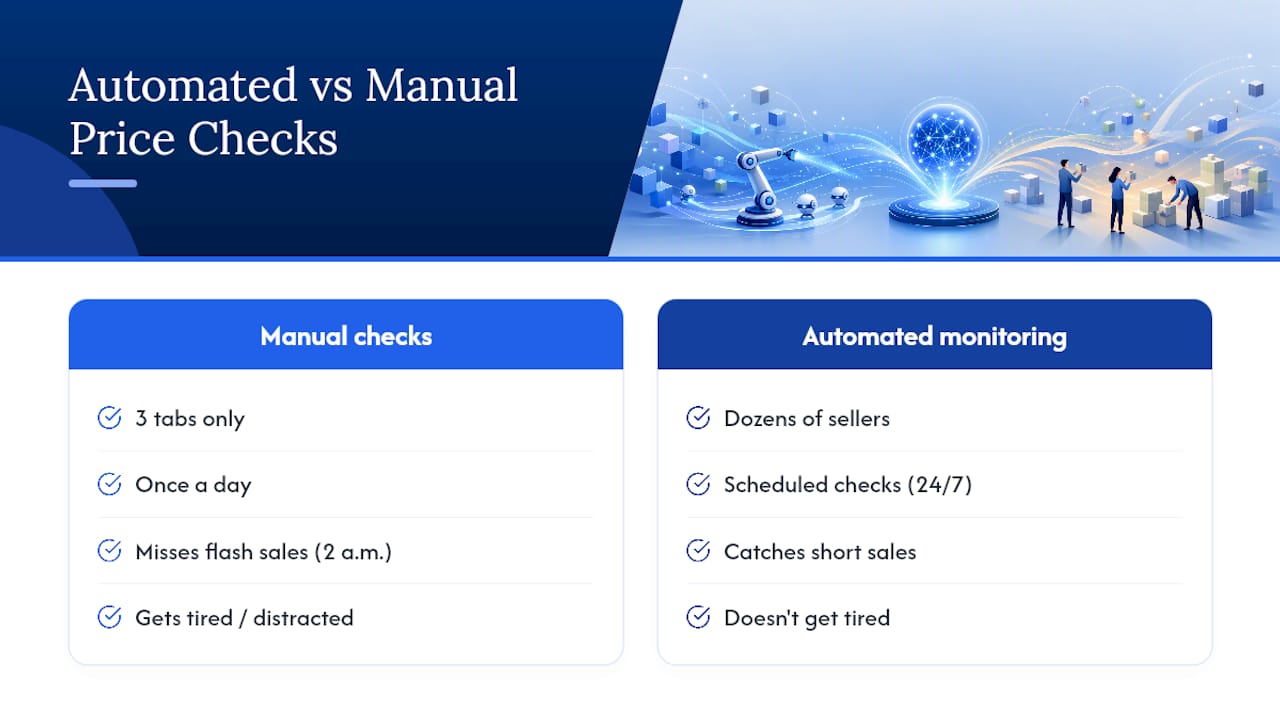
Manual price checking fails in predictable ways. Shoppers compare sticker prices and forget shipping. They match the wrong SKU because two listings look similar but aren’t. They miss short flash sales because nobody’s refreshing a tab at 2 a.m.
Automated monitoring fixes the coverage problem outright. A tool checking dozens of sellers on a schedule catches more price movement than a person checking three tabs once a day ever will, and it doesn’t get tired or distracted halfway through. That said, automation isn’t a replacement for a final human look. Always verify the checkout total yourself before you pay. Alerts get you to the right deal faster; they don’t replace the ten seconds it takes to confirm shipping and tax landed where the tool said they would.
— Timothy
Start Comparing Verified Prices With Aipricesearch
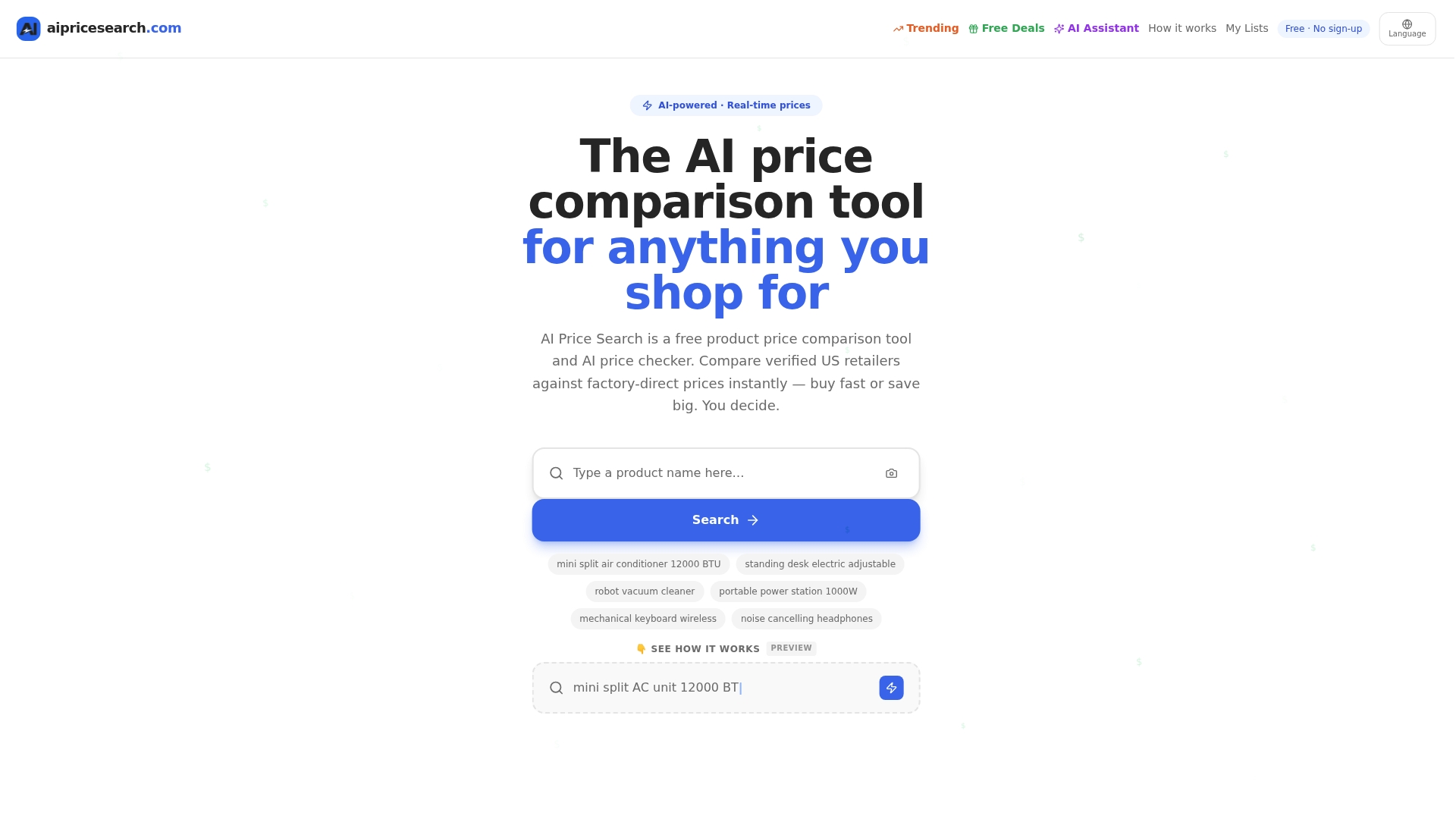
Aipricesearch is built around the exact checklist covered above: broad retailer and factory-direct coverage, total-cost normalization that shows shipping and tax upfront, dropship detection to flag inflated listings, and price-drop alerts tuned to your threshold.
The proof points back it up. Aipricesearch reports average savings of $212 per user this month, and the team publishes ongoing price-tracker reports, including a recent breakdown of Amazon versus Walmart price leadership across 182 weekly searches, showing exactly how often the “obvious” cheaper retailer isn’t actually cheaper once shipping and tax are added.
Paste a product link or snap a photo, set your alert threshold, and let the free comparison tool do the tracking while you go about your week.
Sources
- The role of shipping costs in platform retail competition | CEPR
- Are online and offline prices similar? Evidence from large multi-channel retailers (NBER)
- Vary
Recommended
- Ai Price Search Vs Shopzilla
- Ai Price Search Vs Camelcamelcamel
- Ai Price Search Vs Pricegrabber
- Ai Price Search Vs Pricerunner
Want to compare offers instantly? Search any product on AI Price Search.
Search a price →