U.S. Multi-Store Price Tracking Over $75: Live Checks Include Shipping
September 24, 2026

U.S. Multi-Store Price Tracking Over $75: Live Checks Include Shipping
Use an AI-backed multi-store price tracker that checks live prices and includes shipping and tax, rather than relying on a single retailer’s app. That combination catches real savings instead of stale “sale” signals. Add one product now by pasting its URL, uploading a photo, or scanning its barcode, then set a target price and let the tracker do the comparing while you shop for something else.
TL;DR:
- Live real-time price verification is crucial, as many tools relying on outdated databases can show stale deals or incorrect alerts.
- Considering total cost by including shipping and taxes prevents missing hidden fees or choosing more expensive options when all costs are added.
- Cross-store tracking shows U.S. online prices are only slightly cheaper than in-store prices and often require comparison to find genuine savings.
- Manual checks are essential before high-value purchases, especially when dealing with unfamiliar or small retailers, to verify accurate pricing and availability.
- A reliable tracking tool should have broad retailer coverage, support multiple search methods, and clearly disclose privacy and affiliate practices for trustworthy use.
Table of Contents
- How Multi-Store Price Tracking Actually Works
- Why Cross-Store Price Tracking Pays Off
- What to Check Before You Trust a Price Tracker
- Setting Up Your First Multi-Store Price Alert
- Where Price Trackers Fall Short
- The Data Behind This Guide
- When Tracking Is Worth the Setup Time
- Start Comparing Prices Before You Check Out Next Time
- Sources
- FAQ
How Multi-Store Price Tracking Actually Works
Multi-store price tracking means watching a single product’s price across several retailers at once instead of checking one site over and over. You add an item to a watchlist, the tracker logs its price history, and it alerts you when the price drops to a level you set.
The mechanics matter more than most shoppers assume. Some tools pull from snapshot databases that update once a day or rely on sponsored product feeds, which is why a “deal” sometimes turns out to be yesterday’s price or a listing that already sold out. Others run live web checks at the moment you search or when an alert fires, confirming the number on the actual retailer page right then. That difference between a stale database and a live check is the single biggest factor in whether a price alert is trustworthy.
Alerts typically work one of two ways:
- Percentage-based triggers notify you once a price drops a set amount, say 15% below the original listing.
- Target-price triggers notify you the moment an item hits a specific dollar amount you choose.
Both approaches only work if the underlying price data is current, which is why live verification matters more than alert design.
Shipping and taxes change the math constantly. A shirt priced at $24 on one site and $27 on another looks like an easy call until you add shipping. If the $24 listing charges $7.45 for standard shipping, a figure close to the average U.S. shipping fee found in 2025. Meanwhile, the $27 listing ships free, the second retailer just became the cheaper option. Any tracker that compares sticker prices alone is comparing the wrong number.
Why Cross-Store Price Tracking Pays Off
Online prices are not automatically the cheapest option, and that’s the first thing worth knowing before you build a tracking habit around them. A widely cited pricing study of 56 major retailers across 10 countries found that U.S. online and in-store prices matched about 69% of the time, and when they differed, online was typically only about 4% cheaper. That’s a modest gap on any single purchase, but it compounds across dozens of purchases a year, and it only shows up if you’re actually comparing.
By the numbers: Only 14% of U.S. retailers offer unconditional free shipping, and the average standard shipping fee runs $7.45, according to a 2025 e-commerce shipping study. Meanwhile, 82% of U.S. shoppers say clear pricing with no hidden fees is essential to a good shopping experience.
Shipping costs do more than nibble at the edges of a deal. Research on platform retail competition shows that shipping fees can flip which retailer is actually cheapest once you total everything up, which is exactly why a tracker that ignores shipping is giving you half an answer. Say a $40 kitchen gadget lists for $36 at one boutique retailer and $40 at a larger marketplace. Add $8 in shipping to the boutique order and $0 to the marketplace order, and the “cheaper” option is actually $4 more expensive.
Shoppers already behave this way instinctively. Profitero’s 2024 Price Wars research found that 82% of U.S. consumers compare prices across retailers before buying, and Amazon led as the lowest-priced retailer with a 14% average price advantage across the items studied. That behavior is smart. Doing it manually across five tabs, four times a week, is not sustainable, which is the entire case for automating it.

What to Check Before You Trust a Price Tracker
Not every tracking tool deserves your attention, and the differences between them are bigger than the marketing copy suggests. Run any tool you’re considering through this checklist before you rely on it for a real purchase decision.
- Coverage. How many retailers does it actually monitor, and does that list include marketplaces, independent boutiques, and factory-direct sellers, or just the big three?
- Freshness. Does it verify prices live at the moment of your search, or does it pull from a snapshot database that might be a day or a week old?
- Total-cost calculation. Does the comparison fold in shipping and estimated tax, or does it only show the item’s list price?
- Search flexibility. Can you find a product by pasting a URL, uploading a photo, or scanning a barcode, not just typing a product name and hoping the match is right?
- Alert options. Can you choose email, text, or push notifications, and set how often you’re notified so you’re not flooded?
- Privacy and affiliate disclosure. Does the tool disclose that it earns a commission on outbound clicks, and does it explain what shopping data it collects?
- Interface. Is there a mobile app or browser extension that fits into how you actually shop, or does it require you to remember to visit a separate website?
Coverage and freshness matter more than any other line on that list, because a tracker that watches 200 retailers with week-old data is less useful than one that watches 40 retailers with prices confirmed in real time. Industry observers have flagged this exact problem with older browser extensions: many still lean on outdated snapshots or sponsored placements, which is part of why live-verified, AI-driven checks have become the more reliable standard for catching real deals.
Pro Tip: Before trusting any single “lowest price” badge, hover over the number or tap for details. Tools that show their total-cost math, item price plus shipping plus tax, are more trustworthy than ones that just flash a green checkmark.
A tool that supports image search and AI-based product matching solves a real problem: text searches often miss items with inconsistent naming across retailers, while a photo match finds the exact product regardless of how each seller titled the listing.

Setting Up Your First Multi-Store Price Alert
Getting a working alert takes a few minutes, and doing it in the right order avoids most of the false starts people run into.
- Grab the product identifier. Copy the retailer URL, save a clear photo of the item, or note the UPC or barcode. Any of the three works, but a UPC is the most precise if the product has one.
- Add it to your tracker. Paste the URL, upload the image, or use a browser extension to pull the product straight off the page you’re viewing.
- Set your alert threshold. Choose a target price or a percentage drop, and pick how you want to hear about it, email, text, or push notification.
- Confirm shipping assumptions. Check whether the tracker is factoring in shipping automatically or whether you need to enter an estimated shipping cost manually for accuracy.
- Run a live check and test the alert. Trigger a manual price check to confirm the tool is pulling current data, not a cached number from earlier in the day.
- Watch for duplicate or mismatched listings. The same product often appears under slightly different titles across sellers; matching by UPC or manufacturer part number avoids tracking the wrong variant by mistake.
That last step trips up more people than any other part of the process. A “$15 cheaper” alert is worthless if it’s actually pointing you to a different color, a refurbished unit, or a bundle missing a part you need. Cross-check the listing photo against the one you started with before you click through and buy.
Where Price Trackers Fall Short
No tracker catches everything, and knowing the failure points ahead of time saves you from a bad purchase decision. Small or niche retailers, local boutiques, regional chains, or brand-direct stores that don’t run large affiliate programs, are the sites most likely to get missed entirely, simply because they’re harder for automated systems to index consistently.
Stale data is the other recurring problem. A tool pulling from a database that refreshes weekly can show you a price that vanished days ago, and by the time you click through, the retailer has already raised it back up. Affiliate relationships add another wrinkle: a tracker that earns a commission from certain retailers has a mild incentive to surface those results more prominently, which is worth knowing even when the tool discloses it honestly.
A few habits limit the damage:
- Do one manual live check on the retailer’s actual page before completing a purchase over $100.
- Confirm the shipping cost shown matches what appears at checkout, not just the estimate on the tracker.
- Use image search when a text match feels off, since it catches variant and bundle mismatches that keyword search misses.
- Set alert thresholds a little conservatively at first; a 20% drop trigger produces far fewer false alarms than a 5% one.
If a deal looks unusually good and the retailer is one you’ve never heard of, that’s exactly when a manual check earns its five minutes.
The Data Behind This Guide
This guide draws on peer-reviewed pricing research alongside first-party analysis from Aipricesearch’s own product searches. An examination of 225 product searches found Amazon came out as the cheapest verified retailer in 51% of cases, a finding that lines up closely with Profitero’s broader industry research showing Amazon’s frequent price advantage. A separate internal review across 153 shopper queries in August produced a similar pattern, reinforcing that no single retailer wins every category every time, which is precisely why cross-store comparison beats loyalty to one site.
AI Price Search is built around the checklist above: it pulls prices from verified U.S. retailers and factory-direct sources, checks listings live rather than from a cached database, and factors in total cost including shipping and tax rather than showing sticker price alone. Users this month reported average savings, a figure the platform tracks internally as it compares listings across sellers. That number will vary by shopping habits and category, but it reflects what happens when total-cost comparison replaces single-site checking as the default habit.
When Tracking Is Worth the Setup Time
Not every purchase deserves a tracker, and pretending otherwise leads to alert fatigue that makes you ignore the notifications that actually matter. I’d set up tracking for anything over $75, for seasonal purchases like holiday electronics or patio furniture, and for anything you buy on a repeating basis, like a specific vitamin or a printer cartridge. Skip it for a $12 phone case. The setup time isn’t worth the marginal savings.
Electronics, appliances, and furniture tend to produce the widest price swings and the biggest dollar savings, since list prices on those categories move often and margins between retailers vary widely. Prices on big-ticket seasonal items often keep drifting down as a sale date approaches, so patience usually beats urgency.
— Timothy
Start Comparing Prices Before You Check Out Next Time
Most price comparison tools stop at the sticker price, leaving you to do the shipping and tax math yourself before you know which retailer actually wins. AI Price Search closes that gap by pulling live prices from verified U.S. retailers and factory-direct sources and ranking them by total cost, not list price alone.
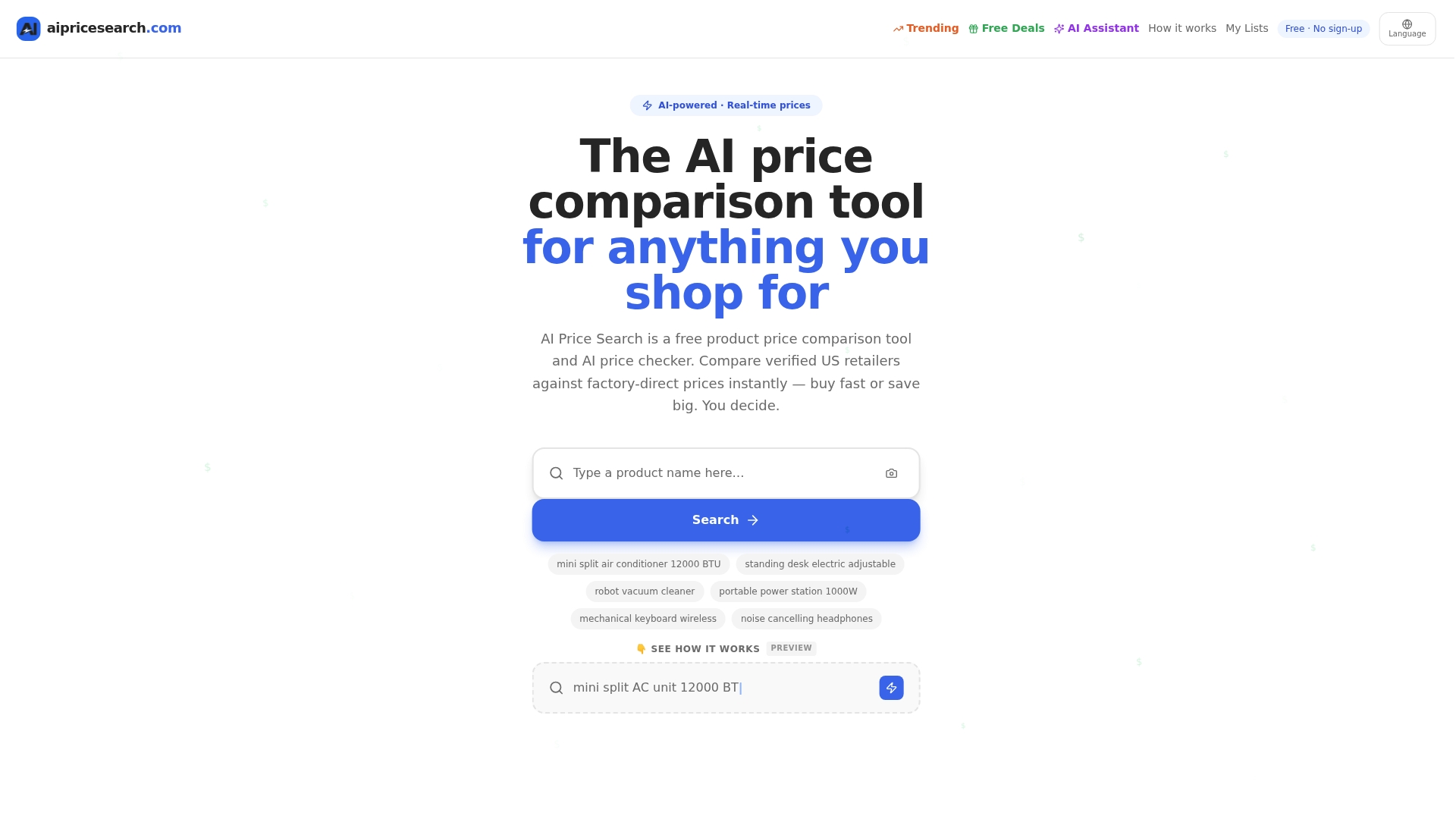
That means:
- Live-verified prices instead of cached database snapshots
- Search by photo, URL, or barcode when a product name search comes up empty
- Shipping and tax folded into every comparison, not tacked on at checkout
- A dropship detector that flags inflated markups before you click through
If you want to see how a specific item stacks up right now, run a search or build a shopping list with the items you’re watching, and let the comparisons come to you instead of hunting across five browser tabs.
Sources
- Are online and offline prices similar? (Cavallo / HBS / Billion Prices Project)
- The role of shipping costs in platform retail competition (CEPR / Gado et al.)
- Price Wars 2024 US edition (Profitero)
- eCommerce shipping experience study 2025 (parcelLab)
- 82% of U.S. shoppers demand price clarity (VTEX / BusinessWire)
FAQ
What Is the Best App for Comparing Prices Between Stores?
The best option depends on whether you need live-verified prices or just a broad database. AI Price Search checks listings from verified U.S. retailers and factory-direct sources in real time and ranks results by total cost, including shipping and tax, rather than sticker price alone.
What Is the Best Price Tracker Website?
Look for a tracker that verifies prices live instead of pulling from a stale snapshot database, and one that supports image, URL, or barcode search so you’re not stuck typing exact product names. Coverage across marketplaces, boutique retailers, and factory-direct sellers also matters more than a long list of big-box stores alone.
How Do I Set Up a Price Tracker?
Add a product by pasting its URL, uploading a photo, or scanning its barcode, then set a target price or percentage drop and choose how you want to be notified. Run one manual live check right after setup to confirm the tracker is pulling current pricing rather than a cached number.
What Is the Best App for Price Tracking?
The strongest apps combine three things: live price verification, total-cost comparison that includes shipping and tax, and flexible search by image or barcode. AI Price Search covers all three, which is part of why its internal analysis found Amazon was the cheapest verified retailer in 51% of the 225 searches reviewed, so other sellers were cheapest in many cases.