AI Price Matching Across U.S. Online Stores
September 22, 2026

$212 Average Savings: AI Price Matching Across U.S. Online Stores
The smartest move for finding the real lowest price online is using an AI price-matching service that compares total landed cost, not sticker price, across verified retailers and factory-direct sellers. A good one flags dropship markups and sketchy sellers automatically and lets you set alerts so it keeps working after you close the tab. Even then, verify delivery promises yourself. Federal rules already protect you if a seller misses its shipping window.
TL;DR:
- AI price-matching tools accurately compare total landed costs, including shipping, taxes, and handling, across verified retailers and factory-direct sellers.
- Always verify seller reliability and shipping times at checkout to prevent surprises or delays, especially on high-value items.
- Be cautious of dropship listings with unusually low prices, vague delivery estimates, or recent seller accounts lacking reviews, which often indicate fake bargains.
- Set price alerts based on total cost and delivery speed, and verify each claim with direct retailer checks before completing a purchase.
- Most price match requests are resolved within 1 to 3 days if submitted with clear documentation, such as live URL links and timestamps, and exclusions typically include refurbished, open-box, or marketplace listings.
Table of Contents
- How AI Price-Matching Services Actually Compare Prices
- How Do You Confirm You’re Getting the Lowest Total Cost?
- What Red Flags Signal a Fake Bargain or Dropship Listing?
- How to Set Price Alerts That Actually Lead to Good Purchases
- How Do You Request a Price Match From an Online Store?
- What Are the Common Exclusions in Price-Match Policies?
- How Long Does a Price Match Request Take to Process?
- How Do You Document a Price Match Claim So It Gets Approved?
- Realistic Savings and Trade-Offs Using AI Price-Matching
- Compare Total Cost Before You Buy, Not After
- Where to Verify Shopping Protections and Pricing Research
- Sources
- FAQ
How AI Price-Matching Services Actually Compare Prices
An AI price-matching service does three things a manual search never manages at the same speed: it pulls listings from dozens of sources, converts each one into a true bottom-line number, and flags sellers who look unreliable before you click through.
Aggregation comes first. The tool scans verified US retailers and factory-direct marketplace pages for the exact product you’re searching, using model numbers, UPCs, or the image itself to match listings instead of just keyword titles.
Normalization is the part most shoppers skip and regret skipping. A $79 listing with $14 shipping and a five-day handling delay might cost more in real terms than an $89 listing with free two-day shipping. The tool folds shipping, estimated tax, and handling into one comparable total, so you’re ranking apples against apples instead of headline prices against each other.
Seller verification runs alongside pricing. Signals like account age, review patterns, and price gaps versus the rest of the market help detect dropship listings, where a seller has no real inventory and simply marks up a factory-direct price and reships from overseas.
- Image and URL search let you find a product without knowing its exact name or SKU.
- Variant matching prevents you from comparing a 64GB model against a 256GB one by mistake.
- Historical price context shows whether today’s number is actually a good one or a seasonal average.
Where AI still needs backup: confirming that a specific seller will honor its stated return window, or that a listing’s “in stock” claim is current. Shoppers surveyed by the Interactive Advertising Bureau routinely keep other sources on hand to double check what an AI tool surfaces, and that instinct is correct.
Pro Tip: Never treat an aggregator’s total-cost number as final until you’ve opened the actual retailer checkout page. Some sites add shipping or tax only at the last screen.
How Do You Confirm You’re Getting the Lowest Total Cost?
A price that looks great on a comparison screen can fall apart at checkout. Running through a short verification routine before you buy takes two minutes and saves you from the most common online shopping regret: paying more than you thought.
- Match the exact identifier. Confirm the model number or SKU on the listing matches what you intended to buy, not a similar but cheaper variant.
- Add every real cost. Tally shipping, handling fees, estimated sales tax, and any expedited delivery charge to get true landed cost, not the number in bold at the top of the page.
- Check delivery speed against your deadline. A rock-bottom price with a three-week shipping estimate isn’t a deal if you need the item next week.
- Review the return and warranty terms. FTC consumer guidance specifically recommends checking seller terms and total cost before buying, not after.
- Verify stock and listing age. A listing that’s been unchanged for eight months with no reviews is a different risk than one refreshed daily.
- Cross-check at the retailer’s own page. Load the seller’s actual product and payment screens directly to confirm the number an alert or comparison tool showed you.
Retail price dispersion is not a fluke. Researchers studying online retail pricing patterns at UC Berkeley found that heterogeneity among sellers and search costs for buyers keep prices spread out for identical goods, sometimes by a wide margin, even for products with plenty of listings. That’s the entire reason a single glance at one site rarely finds the actual floor price.
What Red Flags Signal a Fake Bargain or Dropship Listing?
Not every low price is a real one. Some are dropship markups wearing a discount disguise, and some are outright misrepresented listings counting on you not to check closely.
Dropship sellers typically list a product close to or slightly under market price, then ship it from a factory or overseas warehouse with a two to six-week delivery window. The listing looks like a deal until you notice the “estimated delivery” date, buried lower on the page than it should be.
Watch for these signals before you commit:
- Specs that don’t quite match the photos, or a description copied from a different listing entirely.
- No visible return policy, or a return window under 14 days with no explanation.
- A seller account created recently with no review history older than a few months.
- A price so far below every other listing that it reads as a pricing error or bait.
- Shipping estimates listed only after you reach checkout, not on the product page itself.
Consumer Reports has documented real cases of this kind of inconsistency, including its investigation into AI-enabled personalized pricing at Instacart, where identical items showed different prices to different shoppers. That’s a strong argument for checking more than one source before trusting any single number.
Pro Tip: Open the seller’s storefront page directly and sort reviews by date. A wall of five-star reviews all posted in the same week is a bigger red flag than a handful of three-star complaints spread over a year.
How to Set Price Alerts That Actually Lead to Good Purchases
An alert that just watches the sticker price is a blunt instrument. The better approach ties your alert to a target landed cost, the number that includes shipping and tax, so you’re not chasing a headline discount that evaporates at checkout.
- Set your threshold on total cost, not list price. Decide the maximum you’ll pay including shipping, and let the alert trigger only below that number.
- Add a shipping-speed filter. If you need an item within a week, exclude alerts tied to sellers with long delivery windows.
- Filter for seller reliability. Prioritize alerts from retailers with established histories over brand-new marketplace accounts, even if the price is a few dollars higher.
- Decide your action threshold in advance. If a price drop matches historical lows, act quickly. If it’s a new low with no price history to compare against, wait for a second data point.
- Chain alerts to a saved list. Track multiple product variants at once so you catch whichever version drops first instead of monitoring one page manually.
IAB’s research on AI-assisted shopping backs this up. Shoppers who set alerts around a real budget number report fewer false alarms than those tracking sticker price alone, since a shipping surcharge or tax swing can quietly erase a “discount.”
How Do You Request a Price Match From an Online Store?
Individual retailers still run their own price-match programs, separate from AI-based total-cost comparisons, and the process usually follows a similar pattern across major chains.
Most stores require the match request within a set window, often 7 to 14 days after purchase, and only for identical items: same brand, same model number, same color or size. You’ll typically need a link or screenshot of the competitor’s listing showing the exact price, in-stock status, and that it ships from the competitor directly rather than a third-party marketplace seller on that competitor’s site.
Eligibility usually depends on a few consistent factors:
Retailers generally exclude marketplace sellers, auction sites, and membership-only warehouse prices from matching. Many also require the competing price to be currently live, not an expired sale or a price you saw last week. Some stores match only their own past sale price if the item drops shortly after you buy it, a policy often called a price-adjustment guarantee rather than a true match.
The request itself usually happens through online chat, a customer service form, or occasionally in person at a physical location if the retailer has one. Have your order number, the competitor’s product URL, and a screenshot ready before you start the conversation. Approval speed depends heavily on how clean that documentation is.

What Are the Common Exclusions in Price-Match Policies?
Price-match policies read generously until you hit the exclusions list, and that list is usually where most requests fail. Clearance items, open-box products, and refurbished units are almost universally excluded, since retailers argue there’s no truly identical comparison to make.
Third-party marketplace listings are another near-universal exclusion. If the competing price comes from a marketplace seller rather than the retailer itself, most policies won’t honor it, even when that marketplace operates under a recognizable retail brand name. Flash sales, doorbuster events, and limited-time promotional pricing tied to a specific holiday are frequently excluded too, since those prices are considered temporary rather than a standard competitive price.
Bundled offers create another gap. If a competitor’s lower price comes with a free accessory, an extended warranty, or a bundled second item, most retailers won’t match it dollar for dollar, since the value isn’t a pure price comparison anymore.
Geographic and membership restrictions matter as well. A price only available to members of a specific loyalty program, or a price shown only in a different region or country, typically doesn’t qualify. And once you’ve already returned an item or the return window has closed, most retailers stop accepting price-match requests entirely, treating it as a closed transaction.
Reading a store’s specific policy page before buying, rather than assuming a generic match applies, saves a frustrating back-and-forth later.

How Long Does a Price Match Request Take to Process?
Most online retailers resolve price-match requests within 24 to 72 hours when the documentation is complete and the item clearly qualifies. Live chat requests tend to move fastest, sometimes resolved in the same conversation, since a representative can pull up the competitor listing in real time and issue a partial refund or adjusted charge immediately.
Email or web-form submissions typically take longer, often two to five business days, because they route through a review queue rather than a live agent. If your claim requires a supervisor’s approval, which happens more often with higher-value electronics or when the price gap is unusually large, expect the timeline to stretch closer to a week.
Adjustments themselves, once approved, usually post as a refund to your original payment method rather than a fresh charge on a new order. Credit and debit card refunds can take an additional 3 to 5 business days to actually appear in your account after the retailer processes them, even though the store’s own system marks the request as resolved sooner. If you paid with a store gift card or store credit, the adjustment sometimes posts back to that balance instantly instead.
Delays usually trace back to incomplete documentation, not company slowness. A blurry screenshot or a competitor link that’s gone stale by the time someone reviews it is the single biggest cause of a rejected or stalled claim.
How Do You Document a Price Match Claim So It Gets Approved?
The claims that get approved fastest all share the same trait: they leave the reviewer nothing to question. A clean screenshot showing the competitor’s price, product name, and model number, captured before the listing changes or sells out, is worth more than a detailed explanation typed into a chat box.
Capture the competitor’s page URL along with the screenshot, not instead of it. Listings get pulled or repriced within hours sometimes, and a URL that leads to a dead page or a different price is functionally useless to whoever reviews your claim. Timestamp matters too. Screenshot software that stamps the date and time automatically removes any doubt about when you saw that price.
Keep your own purchase receipt or order confirmation handy alongside the competitor evidence. Most retailers want to see both sides of the comparison in the same request, not a separate follow-up email. If the retailer’s policy requires the item to be identical down to the model number, include that number visibly in your screenshot rather than assuming the reviewer will search for it themselves.
Submitting through the fastest available channel, live chat over email when it’s offered, also improves your odds simply because a live agent can resolve ambiguity by asking a follow-up question instead of denying the claim outright for missing information.
Realistic Savings and Trade-Offs Using AI Price-Matching
AI Price Search users have reported average savings of $212 this month, which tells you the tool earns its keep on genuinely comparable products with several active sellers. Where it struggles is anything niche or newly released, where fewer listings exist to compare.
I’d treat a fast AI match as a strong lead, not a final answer. Verify shipping speed and seller history before buying, especially on anything over $200. The workflow that actually converts savings into money in your pocket pairs quick AI discovery with a two-minute manual check. Skip the check and you risk trading a real discount for a slow, unreturnable shipment.
— Timothy
Compare Total Cost Before You Buy, Not After
Aipricesearch is the practical alternative to bouncing between five browser tabs trying to add up shipping and tax yourself. The tool compares total landed cost across verified US retailers and factory-direct sellers in one search, flags likely dropship markups through its dropship detector, and lets you search by photo or product URL when you don’t know the exact model name.
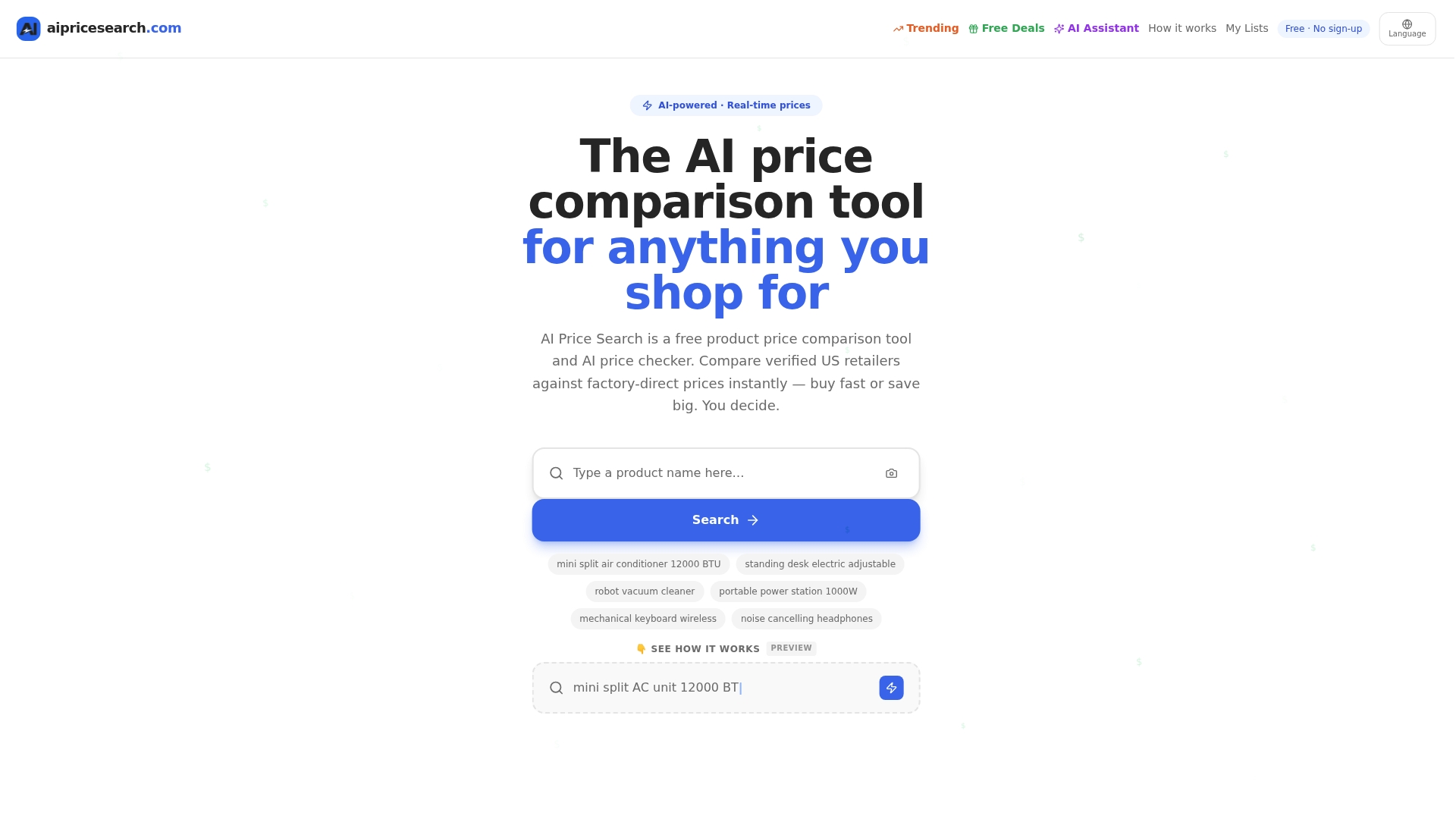
Users have reported average savings of $212 this month, largely by catching total-cost gaps that a headline price alone hides. Set up a saved list through the shopping lists feature for anything you’re tracking over time, and let price alerts do the waiting while you go about your week. Start a search at Aipricesearch and see what your next purchase actually costs once shipping and tax are on the table.
Where to Verify Shopping Protections and Pricing Research
For delivery rights, read the FTC’s Mail, Internet, or Telephone Order Merchandise Rule. For pricing behavior across retailers, see the Consumer Reports price tracker and IAB’s AI shopping research.
Sources
- Mail, Internet, or Telephone Order Merchandise Rule | FTC
- Shop smarter with the Consumer Reports price tracker (2026) | Consumer Reports
- Retail price dispersion research (Berkeley) | rjmorgan
- When AI guides the shopping journey (IAB, 2025)
FAQ
What Does “Price Matching Online Stores” Mean With AI Tools?
It refers to using an AI-powered service to find and verify the lowest total cost, including shipping and tax, across multiple online retailers and factory-direct sellers at once. Tools like Aipricesearch also flag dropship markups and unreliable sellers rather than just listing the cheapest sticker price.
How Accurate Are AI Price Comparisons?
They’re highly useful for surfacing options fast, but accuracy depends on how current the underlying listings are. Shoppers surveyed by the IAB routinely keep other sources on hand to double check what an AI tool surfaces before buying, and that habit is worth keeping.
What Should I Do if a Seller Misses the Shipping Date?
Federal rules require sellers to ship within the time they advertised, or within 30 days if no date was given, or issue you a refund under the FTC’s Mail, Internet, or Telephone Order Merchandise Rule. Contact the seller first, and escalate to your card issuer for a dispute if they don’t respond.
Does Aipricesearch Cost Anything to Use?
Aipricesearch is a free AI-powered price comparison tool, and current details on any additional features are available directly on the site. There’s no published subscription price for the core comparison tool.
How Do I Spot a Dropship Listing Before Buying?
Look for shipping estimates stretching past two weeks, a seller account with little review history, and pricing that sits oddly far below every competing listing. Aipricesearch’s dropship detector flags many of these patterns automatically before you click through to check out.